

Develop your rhythmic reading and timing skills with our free interactive trainer. Generate unlimited exercises, listen to the written rhythms, practise on your instrument and test your timing with immediate percentage scores. Build your confidence across 4/4, 3/4 and 6/8 time signatures.
If you’re new to reading rhythmic notation, start with our free 30-minute guitar lesson. It will introduce you to the fundamentals of rhythm reading and help you understand the notation used in the exercises below.
Being able to read rhythms is an essential musical skill, whether you’re learning guitar, playing in a band or working towards a music examination.
In this free lesson, we’ll look at the building blocks of rhythmic notation, how different note values work together and how to count rhythms accurately.
You’ll learn how to approach written rhythms confidently before putting your skills into practice with our interactive generator.
30-minute video lesson with a free accompanying PDF.
Listen, practise and test yourself using the same exercise and shared performance settings. Both LISTEN and START TEST begin with an audible one-bar count-in.
Develop your ability to read rhythmic notation and understand how written rhythms sound.
Tip: Start slowly and concentrate on accuracy. Increase the tempo gradually as your confidence improves.
Put your rhythm-reading skills to the test by performing the written rhythms and comparing your timing with the correct performance.
Tip: Concentrate on keeping a steady pulse. Focus on rhythmic accuracy before increasing the tempo.
Choose your time signature, difficulty and exercise length. Adjust the performance settings below the notation to suit your practice. For a greater challenge, switch off the metronome or reduce the visual guidance. Use built-in speakers or wired headphones for the most accurate timing assessment.
Rhythm Sight-Reading
4/4 · Level 1 · 1 bar
Ready
The metronome follows the selected time signature. In 6/8, the tempo is measured in dotted crotchets, with six quaver clicks per bar and accents on beats 1 and 4.
Now that you’ve practised reading and listening to the rhythms, it’s time to put them into practice on your guitar.
Start by choosing a single chord and using the generated rhythm as a strumming pattern. Once you’re comfortable, introduce a chord progression and practise changing chords while maintaining a steady pulse.
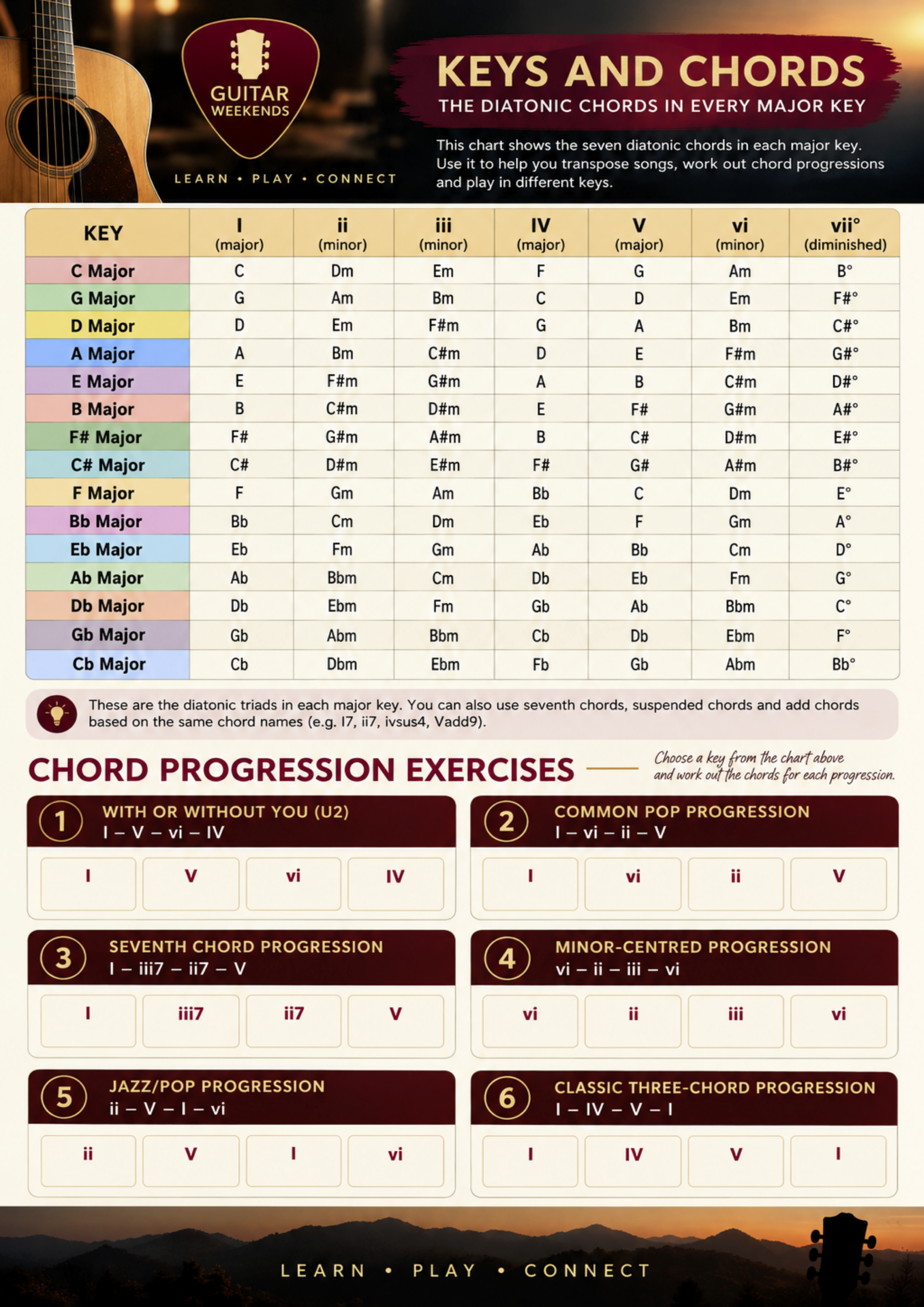
Use our Keys and Chords worksheet below to explore the diatonic chords in different major keys and choose from six chord progression exercises. Try applying the same rhythm to different chord sequences to develop your timing, chord changes and musical confidence.
Now that you’ve practised reading and playing rhythms, why not test your listening skills?
Our free Rhythm Identification Challenge features 90 listening challenges across 4/4, 3/4 and 6/8 time signatures, with six progressive difficulty levels.
Listen carefully, identify the rhythmic patterns and see how many you can get right.