

Develop your rhythm reading, timing and instrumental skills with our free interactive trainer. Generate unlimited exercises in 4/4, 3/4 and 6/8, listen to the written rhythms and test your timing with immediate scores and personalised musical feedback. Add chord progressions to practise strumming, fingerpicking, chord changes and transposition.
If you’re new to reading rhythmic notation, start with our free 30-minute guitar lesson. It will introduce you to the fundamentals of rhythm reading and help you understand the notation used in the exercises below.
Being able to read rhythms is an essential musical skill, whether you’re learning guitar, playing in a band or working towards a music examination.
In this free lesson, we’ll look at the building blocks of rhythmic notation, how different note values work together and how to count rhythms accurately.
You’ll learn how to approach written rhythms confidently before putting your skills into practice with our interactive generator.
30-minute video lesson with a free accompanying PDF.
Listen, practise and test yourself using the same exercise and shared performance settings. Both LISTEN and START TEST begin with an audible one-bar count-in.
Develop your ability to read rhythmic notation and understand how written rhythms sound.
Tip: Start slowly and concentrate on accuracy. Increase the tempo gradually as your confidence improves.
Put your rhythm-reading skills to the test by performing the written rhythms and comparing your timing with the correct performance.
Tip: Concentrate on keeping a steady pulse. Focus on rhythmic accuracy before increasing the tempo.
Turn any generated rhythm into a practical guitar exercise. Develop your strumming, fingerpicking, chord changes and understanding of harmony.
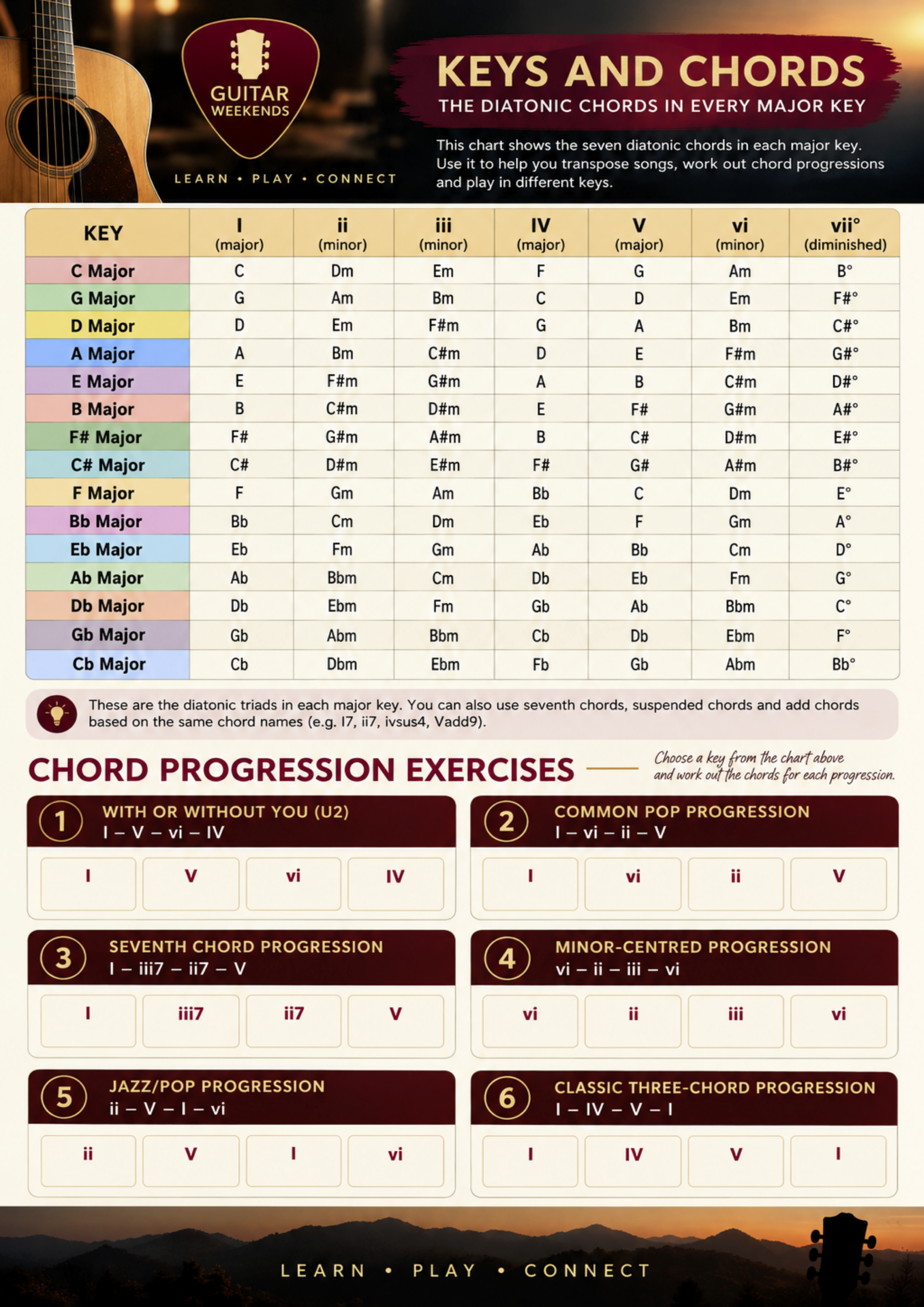
Tip: Start with familiar chords and a slow tempo. Use our Keys and Chords worksheet further down the page to help you work out the chords from Roman numerals.
The piano plays the written rhythm, not the chords. START TEST assesses your tapped rhythm and timing, not the chords played on your instrument.
Choose your time signature, difficulty and exercise length. Enable Chord Progression Practice if you would like to play along using chords. Adjust the performance settings below the notation to suit your practice. For a greater challenge, switch off the metronome or reduce the visual guidance. Use built-in speakers or wired headphones for the most accurate timing assessment.
Rhythm Sight-Reading
4/4 · Level 1 · 1 bar
Ready
The metronome follows the selected time signature. In 6/8, the tempo is measured in dotted crotchets, with six quaver clicks per bar and accents on beats 1 and 4.
Now that you’ve practised reading and listening to the rhythms, it’s time to put them into practice on your guitar.
Start with a single chord and use the generated rhythm as a strumming or fingerpicking pattern. When you are comfortable, enable Chord Progression Practice and work through the harmony levels at your own pace. Try the same progression in different keys, using open chords, barre chords or triads where appropriate. Keep a steady pulse as you change chords.
Use our Keys and Chords worksheet below as a reference for the diatonic chords in different major keys. It also includes six chord progression exercises for independent practice. Try reading the generated Roman numerals, identifying the chords in your chosen key, and then switching to chord names to check your understanding. For seventh and suspended chords, use suitable chord voicings you already know.
Now that you’ve practised reading and playing rhythms, why not test your listening skills?
Our free Rhythm Identification Challenge features 90 listening challenges across 4/4, 3/4 and 6/8 time signatures, with six progressive difficulty levels.
Listen carefully, identify the rhythmic patterns and see how many you can get right.